The Bible Is Weird
Odd Encounters of the Religious Kind | Part 1 of 2

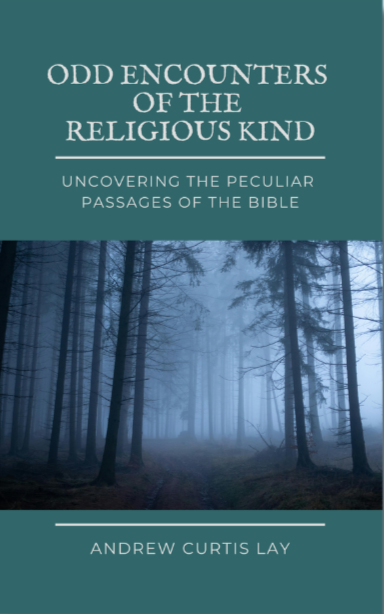
I just published a new book called Odd Encounters of the Religious Kind: Uncovering the Peculiar Passages of the Bible. The book jumps headfirst into seven of the
Bible’s most unusual and mystifying stories: Balaam’s Donkey, King Saul and the ghost of Samuel, Elijah’s food delivery by ravens, Elishas encounter with she-bears, Ezekiel’s vision of the dry bones, Jesus’ encounter with a legion of demons and a herd of pigs, and Paul’s sermon that led to an unlucky moment. This
exploration gives us the chance to embrace the
mystery of the Bible, grapple with its challenges, and
reflect on its truth.
Today's post is an excerpt from this book. Perhaps you have found yourself wrestling with a strange passage of Scripture, not really knowing what to make of it. My hope is that this post, and this book, will help you embrace the weirdness of the Bible.
“Did you know that there’s a witch in the Bible?” “Have you heard the story about the man who was swallowed by a giant fish?” These are the words of my childhood Sunday School teacher. She was the first person to introduce me to the strange and surprising stories found in Scripture. She was fun and outgoing, no questions were off-limits, and she never avoided the difficult or unusual passages. Her excitement is what made the Bible feel even more alive to me as a kid.
I have other fond memories of learning Bible stories with this advanced piece of technology called a felt board. Little cloth characters would be placed on the felt board to tell us kids about all of the different stories in the Bible. We learned about the Flood and Noah’s Ark. We learned about Jonah and the Whale. We learned about David and Goliath. And, of course, we learned about this incredible character named Jesus.
But it was out on the church playground where my education was furthered even more. We would sway back and forth on the swing set, swapping Bible stories the way other kids traded baseball cards. It was on that playground that I first heard about the beheading of John the Baptist. Stories like this fed our morbid curiosity as we engaged in our own conversations of playground theology. We were wide-eyed, curious, and wondering what strange story we might uncover next.
The Bible kind of felt like a hidden treasure, a secret book that we were somehow allowed to read, yet it also felt like it should be off limits. There’s no way our parents actually approve of us reading this stuff! The Bible, in many ways, is a strange book. In fact, it’s really a collection of different books. It was written across centuries, by many different authors. It contains poetry, law, prophecy, historical narratives, wisdom literature, letters, and apocalyptic literature. All these components come together to form the Bible and to tell the bigger story of who God is and how we have come to know God as human beings over time. However, if you’ve spent any time reading the Bible, you’ve likely scratched your head at some of the paradoxes, obscurities, and wonders contained within.
As modern readers, we often struggle with understanding some of the ancient worldviews, supernatural events, strange laws, and symbolic visions. The Bible is full of odd encounters between God and humanity that don’t always neatly fit into the way we see the world. We meet a talking serpent, a runaway prophet swallowed by a giant fish, and a mysterious hand, writing judgment on a palace wall. We hear about Jacob wrestling with an angel, a floating axe head, the sun standing still, and Peter walking on water. There are angels and demons, dreams and visions, monsters and miracles. Many of these stories are downright gruesome and shocking!
The novelist and short story writer Flannery O’Connor is known for her strange and odd short stories, such as “Good Country People,” “Revelation,” and “A Good Man is Hard to Find.” Many of her works carry grotesque and freakish themes, yet she is widely regarded as one of the most influential Christian writers of the modern era, and it’s clear that her faith deeply shaped her writing. In her collected letters, The Habit of Being, O’Connor speaks about her style of writing by saying:
One of the awful things about writing when you are a Christian is that for you the ultimate reality is the Incarnation, the present reality is the Incarnation, and nobody believes in the Incarnation. My audience are the people who think God is dead. At least these are the people I am conscious of writing for.
O’Connor writes these strange stories to seize our attention. She seeks to break through our stubbornness, disrupt our apathy, and shake us out of complacency so that we can grasp the deeper reality of the Incarnation. Her stories remind us that Christianity is strange, God is astonishing, and there is profound beauty in the oddest of places.
O’Connor’s stories are not unlike many of the stories that we encounter in the Bible. The curious stories in Scripture are quick to shock us and grab our attention, but it can be difficult to glean the purpose and meaning behind some of these tales. For many modern readers, the peculiar nature of the Bible can be a stumbling block.
How do we reconcile ancient customs with contemporary ideas? How do we navigate outdated laws that are barbaric, cruel, and violent? What do we do with these old stories that confuse and perplex us?
Unfortunately, the Bible has often been used as a tool to bully, control, and manipulate others. There are times when Scripture has been used to justify evils in this world, such as violence, slavery, and exclusion. However, the fact of the matter is that the Bible is open to interpretation, but that interpretation matters. Different people interpret the Bible in different ways, and it is challenging to navigate everything within the pages of Scripture – through all its irregularities, inconsistencies, and challenging ethics.
So how do we approach a book like this? How do we read ancient stories that are beautiful, disturbing, inspiring, and confusing all at the same time? Christians have wrestled with these questions for centuries, seeking faithful ways to interpret Scripture. Faithful readers of the Bible have never been able to simply read the Bible at face value. Instead, there is always some interpretation that must take place.
In the United Methodist tradition, we use the Wesleyan Quadrilateral as a tool to gain a deeper and fuller understanding of the Bible. The Wesleyan Quadrilateral includes Scripture, tradition, reason, and experience to help shape a faithful interpretation of what the Bible says.
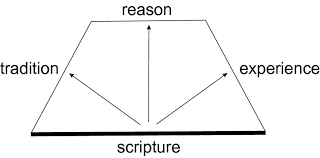
Scripture is the most important source in the Wesleyan Quadrilateral. Studying the Bible can help us better understand who God is and what God’s plan is for the world.
Tradition is also an important aspect of the Quadrilateral. John Wesley would use writings, creeds, teachings, and literature to help find a greater understanding of what it means to be a Christian. Church tradition offers a rich history and foundation for those who subscribe to the Christian faith.
Reason is used as a way to understand what God is calling God’s people to do. Reason is a tool that allows humans to analyze, prioritize, interpret, and interact with the world. Therefore, Christians are free to incorporate and include scientific and social studies, statistics, and academic resources. It is important for reason to be partnered with the other three sources.
Experience is an important way for individuals and a community of believers to interact with Scripture. Experience helps reveal the truth of Scripture through interactions in daily life. Looking at experience as we study the Bible allows us to draw closer to God because of encounters that happen in our own lives.
When we bring these together, the strange and challenging passages of the Bible become less like roadblocks and more like invitations. They become opportunities to wrestle honestly with the text while seeking the deeper wisdom God may be revealing through it.
The beautiful paradox of the Bible is that, even in all its mystery and complexity, it still contains God’s Word. It is still the story of God’s grace and redemptive love for humankind. The peculiar nature of the Bible is not a flaw, but it’s a feature that reminds us of God’s wonder and invites us to explore God’s divine truth.
These strange stories invite us to slow down and dig deeper. They are not always easily digestible or clearly applicable to our lives today. Instead, they force us to be curious, to wrestle with God, and to deal with how these stories speak to us today. The peculiar passages of the Bible are not pointless fairy tales told to entertain us. Rather, they are invitations to look deeper, wrestle harder, and discover the surprising ways God speaks through the unexpected. Yes, the Bible is strange, and we thank God for that.