Embrace the Strange
Odd Encounters of the Religious Kind | Part 2 of 2

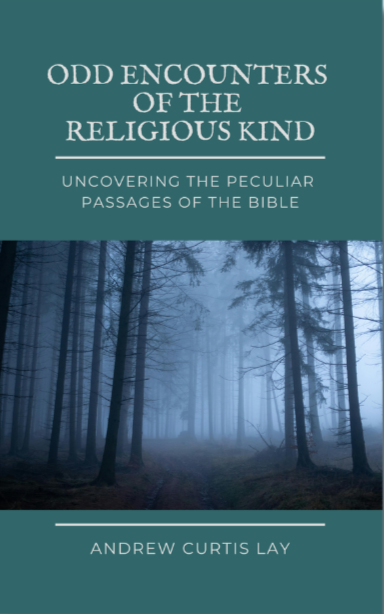
Today’s post is another excerpt from my new book called Odd Encounters of the Religious Kind: Uncovering the Peculiar Passages of the Bible.
It’s an exploration of some of the Bible’s most unusual, puzzling, and often overlooked stories—passages that can leave even seasoned readers scratching their heads.
Perhaps you’ve found yourself wrestling with a strange passage of Scripture, not really knowing what to make of it. Maybe you’ve wondered why it's in the Bible at all. My hope is that this post, and this book, will help you embrace the weirdness of the Bible. Because when we resist the temptation to skip over these odd stories, we often discover that they have something profound to teach us about God, ourselves, and the surprising way God works in the world.
When I think back to my childhood days on the playground, I am thankful that I grew up in a church that allowed me to ask questions and share my doubts. They created and provided a safe space for me to be. I’m thankful that I was given permission to be curious.
Sadly, I think over the years, somewhere along the way, we lose some of that childlike curiosity. Children ask questions without fear: Why did the donkey talk? Why did Jonah run away? Why did Jesus spit in the dirt to heal someone? Over time we stop asking these types of questions, and we trade in our curiosity for clarity and certainty.
As adults, we don’t want to think too hard about our faith. We become nervous about the strange parts of Scripture. We worry that if we admit confusion, it might mean our faith is weak. So instead of wrestling with the difficult passages, we quietly skip over them. We push aside some of the questions, doubts, and hesitations that we have when reading Scripture, and over time, we lose some of that sense of wonder and amazement.
In many ways, that is why I wrote this book. I don’t want people to feel intimidated or frightened when they come across the strange passages in Scripture. The Bible is full of stories that surprise us, confuse us, and sometimes even unsettle us, but those are often the very stories that invite us to dig deeper. My hope is that we will feel free and emboldened to take up the Bible and read it for ourselves. To let the text speak to us, to allow it to challenge us, and to shape us, and ultimately to transform us. I want our children to feel like they can ask their questions without fear, and I want adults to rediscover the courage to ask their questions as well. Faith grows not when we avoid the hard passages, but when we are willing to wrestle with them and let them speak to us.
The Bible is a gift, and we have the opportunity to explore it, study it, and treasure it. Sometimes we miss out on this. The Bible, all sixty-six books, both Old and New Testaments, has been tested by faith and proven by experience. This book is sacred and vital to our faith, because the Bible reveals the Word of God. Because of that, we don’t read it like we would a cookbook. We read it with intentionality, curiosity, humility, patience, reverence, imagination, attentiveness, discernment, openness, expectation, and faith. We read this Bible with a spiritual hunger.
In the book of Revelation, John uses imagery of diving into God’s Word and devouring it like you would a meal. He encourages us to get into God’s Word. John talks about an angel who appears to him. John writes,
So I went to the angel and told him to give me the little scroll, and he said to me, “Take it and eat; it will be bitter to your stomach but sweet as honey in your mouth.” So I took the little scroll from the hand of the angel and ate it; it was sweet as honey in my mouth, but when I had eaten it my stomach was made bitter. Then they said to me, “You must prophesy again about many peoples and nations and languages and kings” (Revelation 10:9-11).
Eugene Peterson has a book that references this moment in Revelation. It’s called Eat This Book, and I love what he says in it. He writes:
Words spoken or written to us under the metaphor of eating are words to be freely taken in, tasted, chewed, savored, swallowed, and digested… A voice told John to take the book from the huge angel. And so he did, he walked up to the angel and said, ‘Give me the book.’ The angel gave it to him, but then said, ‘Here it is; eat it. Eat this book. Don’t just take notes on the sermon. Eat the book.’ And John did. He put away his notebook and pencil. He picked up his knife and fork. He ate the book.
This is an invitation for us to allow the Bible to inform our lives in a deep and meaningful way. It is not just about reading what the Bible says, but it is about living it out. It’s about following the way that Jesus lived out his life.
Peterson writes that God’s Word is “to be freely taken in, tasted, chewed, savored, swallowed, and digested.” He encourages us to get into God’s Word. He writes, “Eat this book, but also have a well-stocked cupboard of Alka-Seltzer and Pepto-Bismol at hand.”
There’s a great story about these four pastors who were talking about different translations in the Bible, and they were talking about which translation was their favorite.
The first pastor said, “My favorite translation of the Bible is the King James Version because it is so eloquent and poetic.” The second pastor said, “My favorite translation is the Vulgate because it was the standard Latin Bible for over 1,000 years.” The third pastor said, “My favorite translation of the Bible is the NIV because it is the one that my congregation understands the best.” Then the last pastor sat there and did not say anything.
After a while, one of the other pastors asked the fourth one. ‘Aren’t you going to say what your favorite translation of the Bible is?’ The fourth pastor paused for a minute and then said, ‘My favorite translation of the Bible has to be my mother’s.’ The other pastors seemed surprised at this response, and they asked, ‘Oh, did your mother write a translation of the Bible?’ The fourth pastor responded by saying, ‘No, but she lived it.’”
The truth is that the most powerful translation of the Bible is not one that is printed on a piece of paper. The most powerful translation of the Bible is actually lived out in flesh and blood. When someone forgives an enemy, that is Jesus’ Sermon on the Mount being lived out in real life. When someone feeds someone who is hungry, that is the Gospel message being fulfilled, that is a translation of the Sermon on the Mount. When someone loves without expecting anything in return, that is an expression of God’s grace being realized. In other words, we have the opportunity, the gift, to offer our own translations. Are we faithful to God’s Word?
We are called to take the words of Scripture, to digest them, and to live them out. And this message can be sweet to us. It can affirm the ways that we are already following God’s will for our lives. It tells us that we are loved, forgiven, and that God is with us always, even to the end of the age. But it can also be bitter because it challenges the ways we live. It can convict us for the ways that we are not following God’s will for our lives. It calls us to forgive when we would rather hold a grudge. It calls us to love our enemies. It calls us to care for the poor and welcome the stranger. Sometimes Scripture comforts us. Sometimes it confronts us. But we are invited to take and eat and share in the message that God has offered to us.
In the summer of 386, Augustine was sitting in a garden in Milan. He had been exploring the Christian faith, but he had not fully committed to giving his life to Christ. In fact, in his memoir entitled Confessions, where he also opened up about his own faith, his doubts, and his struggles in his faith journey, Augustine prayed the prayer, “Please God, make me pure, but not just yet.” Augustine had spent years searching for truth. He studied philosophy, explored different religious ideas, and wrestled with his own desires and doubts. He wanted to believe, but he wasn’t ready to surrender his life to Christ.
But while he was in this garden, suddenly, out of nowhere, he heard a child’s voice say, “Tolle, lege” which means “Take and read.” Augustine picked up Paul’s Letter to the Romans and began reading:
“Let’s behave appropriately as people who live in the day, not in partying and getting drunk, not in sleeping around and obscene behavior, not in fighting and obsession. Instead, dress yourself with the Lord Jesus Christ, and don’t plan to indulge your selfish desires” (Romans 13:13-14).
In this moment, Augustine’s life changed forever. This was his conversion, and he was baptized on Easter Eve in the year 387. Saint Augustine went on to be one of the most influential and prolific Christians in all of history.
Scripture has a way of transforming our lives. Scripture has a way of surprising us like that. Sometimes it comforts us. Sometimes it challenges us. Sometimes it leaves us scratching our heads. But again and again, it invites us deeper into the mystery of God.
These strange stories in the Bible wake us up and shake us out of our old way of doing things. They remind us that God is bigger than our expectations and more creative than our imagination.
When I think back to those childhood days on the playground, I remember that feeling of wonder and curiosity. The world felt big and mysterious, and my faith felt like an adventure. May you rediscover some of that wonder. So, keep asking questions. Keep wrestling with the text. Keep reading the strange stories. Embrace the strange. Take and Eat!