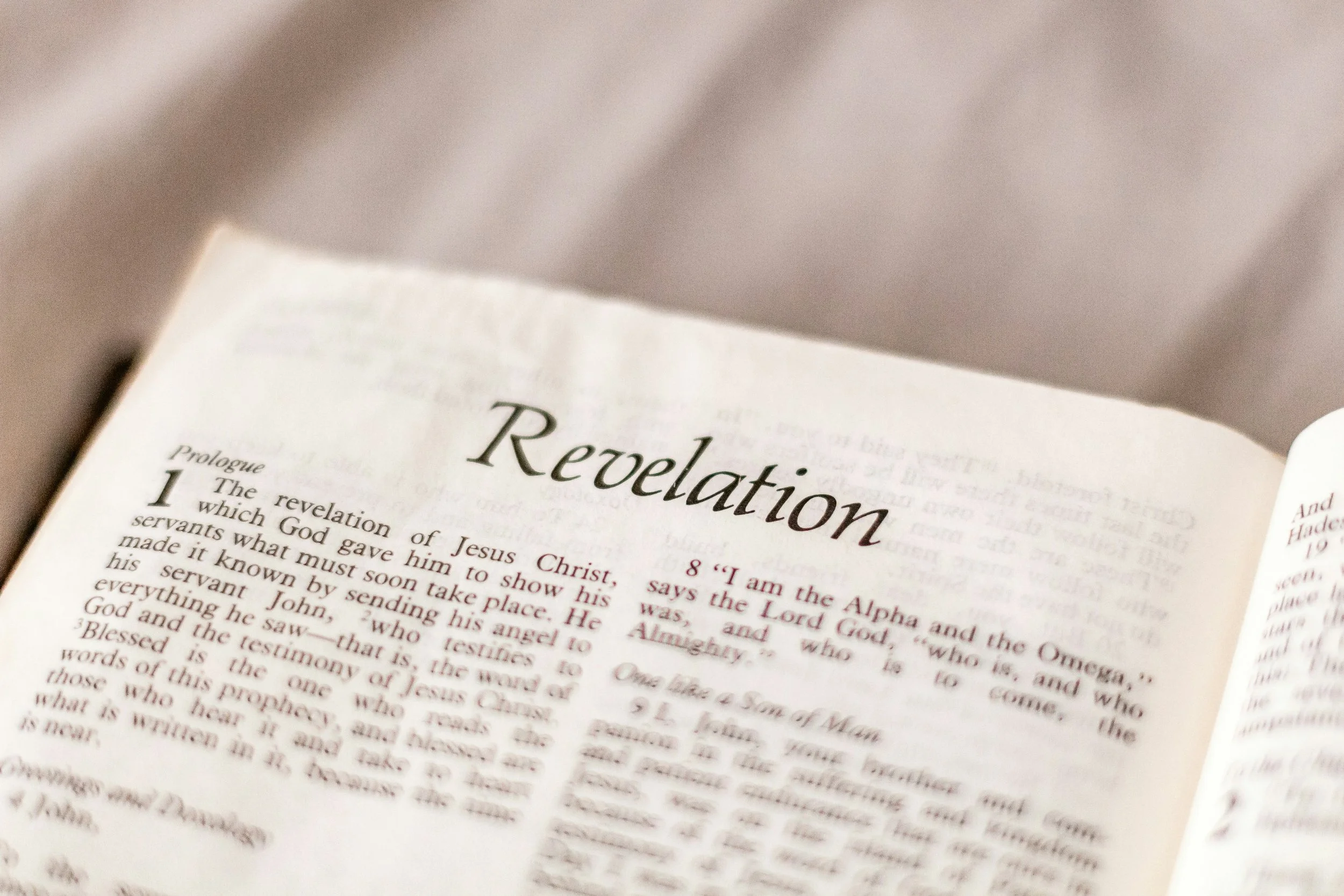
Photo by Sincerely Media on Unsplash
I recently taught a study on the book of Revelation with a colleague and friend of mine. You can watch those sessions here.
For many people, Revelation feels intimidating, confusing, and maybe even frightening. As a result, it’s often avoided and misunderstood. For others, Revelation is overanalyzed. People will often use charts and timelines and attempt to decode the true meaning behind it all. But Revelation was never meant to scare us or confuse us. Nor was it written as an equation to solve. Instead, the book of Revelation was written to reveal—to pull back the curtain and help us see God more clearly.
Eugene Peterson writes: “John’s Revelation is not easy reading. Besides being a pastor, John is a poet, fond of metaphor and symbol, image and allusion, passionate in his desire to bring us into the presence of Jesus believing and adoring. But the demands he makes on our intelligence and imagination are well rewarded, for in keeping company with John, our worship of God will almost certainly deepen in urgency and joy.”[i]
The book of Revelation is so different from many of the other books of the Bible. And so it can be difficult and tedious to read at times. But my hope is that these seven tips will be helpful in how you approach reading this book.
Seven Tips for Reading the Book of Revelation
1. Have an open mind. Don’t be scared or intimidated.
One of the best places to approach Scripture is out of a place of curiosity. If we come thinking we already know or that we already have it figured out, then we have missed something from the start. We also need to be okay with the possibility that studying the Bible might open up new questions for us as well. And that’s okay! Studying Scripture keeps us thinking, growing, and learning as we go!
I was interested to learn that many of the key theologians throughout history struggled with how to approach Revelation. In fact, the Protestant Reformer Martin Luther did not care for Revelation at all. And his fellow Reformer, John Calvin, wrote a commentary for every book in the New Testament except for Revelation. Many people are scared or intimidated by this book. But the truth is, Revelation was written to give the church encouragement and hope in the face of persecution. It was not written to scare us.
And so we have an opportunity to approach this book with an open mind, with curiosity, and with a goal of deepening our understanding of God.
2. Take it seriously, not literally.
The Swiss theologian, Karl Barth once said, “I take the Bible too seriously to take it literally.” Now, to be clear, there are many places where we are to take the Bible literally. But like any piece of literature, there are places that should not be taken literally.
The parables are a great example of that. When Jesus says, “Heaven is like a mustard seed… or a woman baking bread,” Jesus didn’t mean that literally. He was using it as a way to describe something deeper. Another example is when Jesus says, “If your eye causes you to sin, gouge it out and throw it away.” Again, Jesus doesn’t mean that literally. He’s using this as a way to talk about how we should deal with our sin in a serious way.
The book of Revelation is filled with symbols and images that are used as metaphors to describe a deeper truth. For example, Christ is portrayed as The Lamb representing love, sacrifice, and victory. We know that Jesus isn’t a Lamb, but we are familiar with this image of the Sacrificial Lamb. So, it’s important to read Scripture seriously but not always literally.
3. Consider the Genre of Apocalyptic Literature.
The word apocalypse means “unveiling.” In Apocalyptic Literature (like in Daniel and Revelation) symbols and images are used to “unveil” a deeper truth. We do the same thing today. We use symbols and images to communicate things all the time. When we see an eagle, we think about America. When we see a donkey, we think about Democrats. When we see an elephant, we think about Republicans. We can see these animals in a political cartoon and know what it means, but people from other parts of the world might not understand these symbols the way we do in America. That’s the same principle in Revelation.
The author, John, is describing his visions and dreams using symbolic language. This type of writing uses primarily figurative terms. Revelation was written during a time when Apocalyptic writing had become quite popular in Jewish literature. There are other books written in this same style, such as The Apocalypse of Baruch, Enoch, The Fourth Book of Ezra, the Ascension of Isaiah, and The Apocalypse of Zephaniah.
4. Remember the original audience.
Revelation was first written to seven churches in the Roman Empire in the area of Asia Minor which is modern-day Turkey. Scholars believe it was written at some point between 69 and 96 A.D. This is a letter that was written to a specific group of people during a specific time in history. These early Christians were living under the persecution of Rome, and the message of this book offers hope, guidance, and accountability in the midst of their suffering. It also points to a future that God envisions when God will establish God’s kingdom at the end of time.
We need to read Revelation for what it is… which is first-century Judeo-Christian literature. It is in the Jewish tradition of writing, in vision language. In our minds, these apocalyptic symbols sound very strange. But for this First Century audience, it would have been very easy for them to understand and decode.
As we read this book, it is important to keep in mind who these words were first intended for. Now… these words are still very meaningful for us today, but we must first remember the historical context of John’s time, place, and audience.
5. Focus on the main message. Don’t get stuck on the details.
Sometimes we make the mistake of taking Scripture apart piece by piece rather than viewing it as a whole. And if we examine every single word individually and without looking at it with the broader context in mind, we end up losing sight of what the message is really about. In other words, we don’t want to major in the minor. We want to keep the main thing, the main thing. We can be wrong about specific details but still be correct about the overall meaning. Ultimately, Revelation is about God’s victory, Christ’s faithfulness, and the promise that God will get God’s way in the end.
6. Look within the context of the greater Biblical story.
The book of Revelation is a part of the Bible, and so we need to read it within the context of the whole Bible. It can’t be isolated and read by itself as a separate document, because Revelation does not stand alone. It’s important to read this book in the context of the larger biblical story.
In fact, Eugene Peterson argues that “Everything in Revelation can be found in the previous sixty-five books of the Bible… The truth of the gospel is already complete, revealed in Jesus. There is nothing new to say on the subject. But there is a new way to say it.”[ii]
The book of Revelation is full of allusions to the Old Testament. Counts vary, but most scholars believe that there are over 245 references to the Old Testament. Some say over 400 - some say far more - But the point is, the author, John, is pulling images that would be familiar to a Jewish audience. We can’t ignore these references to the wider story in Scripture.
7. Don’t attribute every symbol to today’s headlines.
This is a Big One! The author and theologian, G.K. Chesterton once said that “though St. John the Evangelist saw many strange monsters in his vision, he saw no creature so wild as one of his own commentators.”[iii]
Not everything should be attributed to something. We have to be very careful when we point to something going on in our modern day and attribute it to words written 2,000 years ago. This book was not written to be used as a code book that points to prediction of modern-day events. AND… it is not a secret predictive code about the timing of the end of the world. Instead, it is a poetic letter that points to God’s ultimate victory over sin and death. We can ask the question, “Is this really what John is saying, or am I putting words in his mouth?”
Misconceptions and Misinterpretations:
There are a lot of different ways that people have interpreted the book of Revelation over the years. Unfortunately, Revelation has been misused as a way to try to scare people or predict the end of the world. There are people out there who have written books, created theories, and made predications that have nothing to do with the book of Revelation. But it has left people feeling uncertain and fearful. False interpretations and bad theology have hurt a lot of people and turned a lot of people away from the church.
This book is not meant to be used as a way to try to predict the end times. Jesus himself even said we can’t predict this. Matthew 24:36 says, “But nobody knows when that day or hour will come, not the heavenly angels and not the Son. Only the Father knows.” And so, we need to be very suspicious of anyone who says, “This is when the end of the world is going to happen.” That’s not biblical. We don’t know when Jesus’ Second Coming will take place, or how it will take place, but Jesus simply tells us to watch and wait – to be ready.
But again, I want to reinforce this idea that the purpose of the book of Revelation is not to scare us or make us fearful. The book of Revelation is to give us hope and assurance that Jesus truly is who we say he is, and that our loving and steadfast God will one day restore and redeem everything.
The book of Revelation tells us that Jesus is not dead and gone. Jesus is risen, and Jesus is present among his churches in the midst of their suffering and persecution. And this book speaks to the promise that Jesus’ resurrection appearances are not over. We believe that Christ will come again. My hope is that this series will help redeem this book for us.
I love the way Alan Brehm explains this. He writes, “When we think of end-time scenarios that depict the destruction of the world, we need to remember that the God who is the Alpha and Omega will act no differently at the end of all things than at the beginning of all things.”[iv]
In other words, God doesn’t suddenly have a personality change in the book of Revelation. We can see how God is a loving and steadfast God all throughout scripture, and this is the case in the book of Revelation as well.
In his book on Revelation, Bruce Metzger tells us, “The focus of the Book of Revelation is the Second Coming of the Lord Jesus Christ and the definitive establishment of God’s kingdom at the end of time.”
And so, Revelation speaks to the Seven Churches in their day and time, but it is also a vision for a future where God’s kingdom is brought here on earth.
I hope that these tips and the addressing some of these misconceptions are helpful as we think about how to approach the Book of Revelation.
[i]. Eugene H. Peterson, preface to Revelation, in The Message: The Bible in Contemporary Language (Colorado Springs: NavPress, 2002), 514.
[ii]. Eugene H. Peterson, Reversed Thunder: The Revelation of John and the Praying Imagination (New York, NY: HarperCollins, 1988), xi.
[iii]. G.K. Chesterton, Orthodoxy (New York, NY: John Lane Co., 1908), 29.
[iv]. Alan Brehm, “The Waking Dreamer,” The Waking Dreamer, accessed January 21, 2026, https://thewakingdreamer.blogspot.com/2009/11/world-without-end-ps.html.