Hannah’s Sour Hour of Prayer
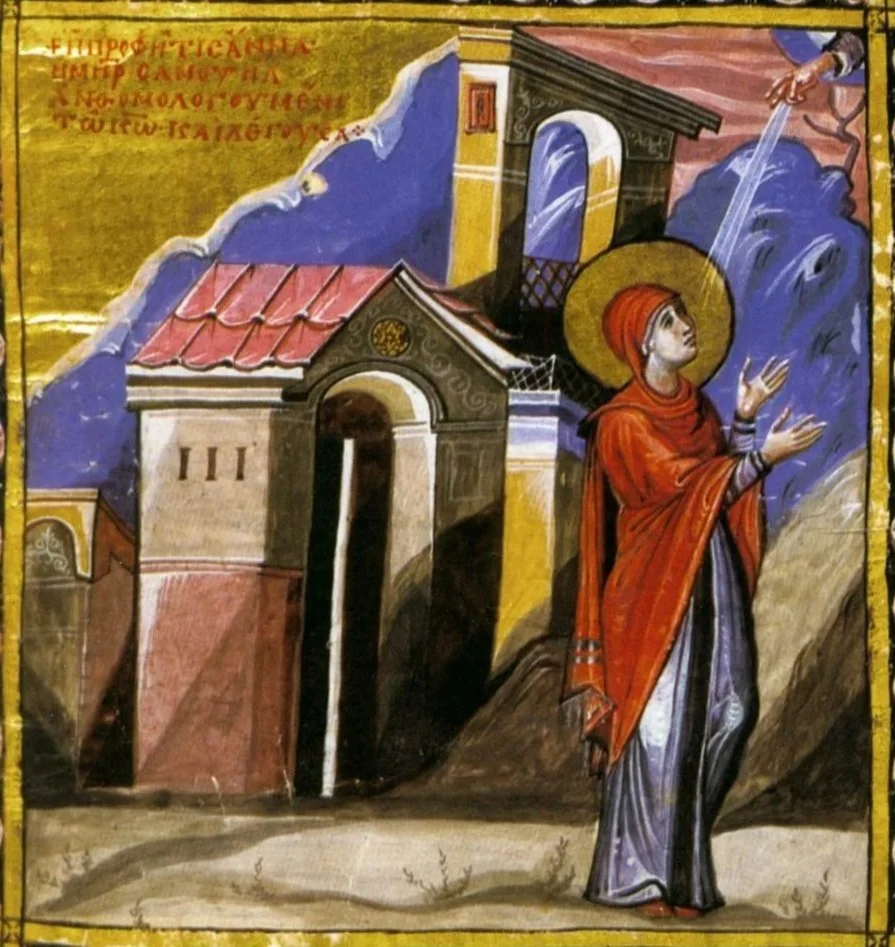
From the Paris Psalter
1 Samuel 1:10–20 (CEB)
Hannah was very upset and couldn’t stop crying as she prayed to the Lord. Then she made this promise: “Lord of heavenly forces, just look at your servant’s pain and remember me! Don’t forget your servant! Give her a boy! Then I’ll give him to the Lord for his entire life. No razor will ever touch his head.”
Our daughter Jane loves to pray, especially before mealtimes, and she always says the same prayer. It’s one she learned at school. She says: “We are thankful. We are glad. For the many great things. That we have.”
It’s a very sweet prayer.
One day I decided to teach her the Johnny Appleseed prayer. I sang it to her and when I was done, she looked at me and said, “Wow, daddy. That was very good.”
I had to break the news to her that I didn’t come up with it. It’s an old blessing.
Our prayers can be sweet and sentimental, like the songs of a child. They can be melodic words that we share at the dinner table or before bedtime. Oftentimes, our prayers are full of words of gratitude and thanksgiving. We pray in worship, we pray communally, we pray together. We thank God for all the many blessings we have in this life.
These types of prayers remind me of the hymn, “Sweet Hour of Prayer.” It says:
Sweet hour of prayer
Sweet hour of prayer
That calls me from a world of care
And bids me at my Father's throne
Make all my wants and wishes knownIn seasons of distress and grief
My soul has often found relief
And oft escaped the tempter's snare
By Thy return, sweet hour of prayer
It’s true. Our prayers can be sweet and sentimental.
But there are times when our prayers can also be quite sour.
And if anyone could relate to this “Sour Hour of Prayer,” it is Hannah.
At the very beginning of the book of First Samuel, we are told that there is a man named Elkanah who has two wives. One of his wives, Peninah, is having children left and right. The other one, Hannah, can’t have any children at all.
To make matters worse, the one having babies taunts the one who cannot. These moments bring Hannah to tears, and she is unable to eat. It’s a horrible situation.
One of the most difficult things about infertility is dealing with the comparisons. There was a time when Ally and I were dealing with infertility. And Ally said that it felt like every time she got on Facebook, she saw that someone she knew was pregnant.
It felt very isolating.
That can be difficult to deal with, and we see that played out in Hannah’s story.
When Prayer Becomes Sour
One day, they go on their annual pilgrimage to Shiloh, which is a place of worship and prayer. And Hannah takes this opportunity to pray to God. Out of this place of deep anguish and pain, she comes to God in her bitterness. She comes out of this sour place in her life.
There is a book called Prayer by Ole Hallesby that talks about the way we regard doubt, anger, and bitterness as obstacles to prayer. But in reality, they are actually a pathway into prayer. These emotions are the things that we bring with us when we go to God. These are the things that we talk about when we talk to God.¹
This is something that Hannah understands.
She goes to God in prayer, and she ultimately turns this prayer into a vow before God. She says:
“Lord of heavenly forces, just look at your servant’s pain and remember me! Don’t forget your servant! Give her a boy! Then I’ll give him to the Lord for his entire life. No razor will ever touch his head.”
—1 Samuel 1:11 (CEB)
She asks for a child, but she also promises to give that child back to God.
It’s like she is striking a holy bargain with God.
She is essentially promising that her child will become a “Nazirite,” that is, a person who is dedicated to God—and that dedication is expressed through growing out your hair. One example we often think about is Samson, a Nazirite who found his strength in his long hair.
She is making this lifelong promise to God, in hopes that God will answer with the gift of a child.
The whole time that Hannah is praying, she thinks that she is praying in solitude and silence. She thinks that she is alone. But Eli, the presiding priest at Shiloh, is sitting in a chair by the doorway, watching her.
Eli sees her lips moving, but no sound is coming out. She is praying silently—but with so much intensity—that Eli assumes she must be drunk.
Interestingly, this isn't the last time in Scripture that someone deep in prayer or filled with God’s Spirit is mistaken for being intoxicated. On the day of Pentecost, the followers of Jesus are also accused of being drunk. Peter quickly dismisses the accusation, saying, “These people are not drunk, as you suspect; after all, it's only nine o'clock in the morning!” Acts 2:15 (CEB).
But you have to remember, Eli is a priest. To him, the normal way of prayer follows the traditional rules of Israel’s worship. Prayer happens through ritual, incense, animal sacrifices, and communal prayers led by the priesthood.
Hannah's silent, deeply personal prayer doesn't fit those expectations.
Hannah has no animal to sacrifice. She doesn’t ask the priest for guidance or intercession. There is no intermediary between her and God. She surpasses the help of the clergy and uses her own voice.
She pours out her heart and lays it all on the line.
It’s real, it’s raw, it’s unusual.
From Eli’s point of view, it’s improper.
This is not the way that people are supposed to pray!
Eli looks at Hannah and sees nothing but a drunk, and he reprimands her. He accuses her of violating this sacred place of worship. He says:
“How long will you act like a drunk? Sober up!”
—1 Samuel 1:14 (CEB)
Hannah is a remarkable woman.
She does not lie down. She does not shrink away from this rebuke. In a time when women are not highly regarded, Hannah speaks up for herself.
She says:
“No sir! ... I’m just a very sad woman. I haven’t had any wine or beer but have been pouring out my heart to the Lord. Don’t think your servant is some good-for-nothing woman. This whole time I’ve been praying out of my great worry and trouble!”
—1 Samuel 1:15–16 (CEB)
She justifies her prayer out of her need.
“No, I’m not drunk. I’m just a deeply troubled woman!”
She shares her bitterness, her frustration, and her anger. She is pouring out her heart to God in the midst of all of her pain and disappointment.
To his credit, Eli hears Hannah’s response. He recognizes that Hannah’s inward, silent prayer is a genuine one. So, he blesses her and he joins his prayers to hers.
Eli says:
“Then go in peace. And may the God of Israel give you what you’ve asked from him.”
—1 Samuel 1:17 (CEB)
Hannah goes on her way, and she is finally able to eat.
And then, once she returns home, Hannah becomes pregnant.
God answers Hannah’s prayer.
She gives birth to a son, and she names him Samuel. It means, “The One Who is God-Named” or “The One Asked For.” The name Samuel echoes the words of Hannah’s prayer.
There are so many stories like this throughout Scripture—a barren woman struggles with infertility for years until God finally gives the gift of a child.
Sarah, the wife of Abraham, gives birth to Isaac when she is 90 years old.
Rebekah, the wife of Isaac, gives birth to twin sons, Jacob and Esau, after Isaac prayed for her.
Rachel, the wife of Jacob, eventually gives birth to Joseph and Benjamin.
Manoah’s wife gives birth to Samson, after being visited by an angel of the Lord.
The Shunammite Woman offers hospitality to the prophet Elisha, and she is promised a son.
And then, of course, we think about Elizabeth and Zechariah, who eventually give birth to John the Baptist.
We see this story played out time and time again.
In each of these stories, women are barren, unable to have children, but then God answers their prayers with the gift of a child.
But we know that things don’t always happen that way.
My aunt and uncle struggled with infertility for many years, and they eventually received the news from their doctor that they would never be able to have children.
In the wake of that moment, they decided to get away and take a vacation. They went to the Happiest Place on Earth, Disney World.
The only problem was that everywhere they looked, they saw parents with their children. It was a constant reminder to them that they would never have any.
So, they ended up hiding away in their room for most of their vacation.
He didn’t have much to do, so my uncle started reading a biography about Walt Disney that he got in the gift shop. The book talked about how Walt Disney and his wife, Lillian, had given birth to their daughter Diane, but then they suffered several miscarriages.
And so, after three years, they made the decision to adopt their second daughter, Sharon, as an infant.
It was after reading that book that my aunt and uncle decided to adopt their two daughters.
They weren’t able to have children on their own, but they were able to have children through adoption.
And we know that there are many who aren’t able to have children, even through the process of adoption.
What We Do With God's Gifts
But I think that is why Hannah’s story is so powerful.
After all, Hannah prays and prays to God for a child. And when God finally gives Hannah a child, she doesn’t do what we might expect.
She doesn’t cling to him.
She doesn’t hold on to him for dear life.
No, she remembers her promise. She remembers her deal.
She gives the child back to God.
She finally receives the gift of a son, but she turns back around and offers this gift back to God.
Mother Teresa once said:
“Do not tire of giving, but do not give your leftovers. Give until it hurts, until you feel the pain. If you give what you do not need, it is not giving.”²
It makes me wonder, what would it mean for us to pray to God for something that is most precious to us, and then, when we get it, instead of clinging to it, we give it back to God?
What would it look like in our lives to receive God’s gifts, not to hold to them for dear life, but to use them for God’s purpose, thus, giving them back to God?
Retired United Methodist Bishop Will Willimon used to teach a class where he asked students to write a paper entitled, “My Call to the Ordained Ministry.” In the paper, they had to describe how they felt called and why they believed God was calling them to become a pastor.
As you can imagine, over the years he received some pretty interesting papers.
But he tells the story of one student who wrote:
“I was a teenager from hell. I made my parents’ lives miserable. I was so irresponsible that I flunked out of college in six months. Then I met this person, we lived together for a while, and we got married. And then, for some reason, we started attending this little church in the neighborhood where we were living. Gradually, I came to the surprising conclusion that God had some kind of plan for my life. I started thinking about going back to college and eventually going to seminary to become a preacher.”
He said:
“I dreaded telling my parents. After all they had been through with me, now I was going to tell them that my life had taken yet another strange and surprising turn. I just hated the thought of telling them.”
But eventually, he sat down with his parents. He told them he was going back to college, and he shared with them the surprising turn his life had taken—that he felt called to become a pastor.
And as he was telling them, his mother suddenly burst into tears. She looked at him and said over and over again, “I’m just so ashamed.”
He said, “I couldn’t believe it! I thought she would be excited. I thought she would rejoice.”
But then she said:
“Didn’t I ever tell you that before I had you, I had a number of miscarriages? I was so disappointed. I didn’t think I would ever be able to have a child. But when I got pregnant with you, I prayed to God and said, ‘God, if you will let me carry this baby to term, I will dedicate him to the Lord just like Hannah did in the Old Testament. I will even name him Samuel, just like Hannah did. If you will just let me have this baby, he will be yours forever. I promise.’”
Sam said, “That’s unbelievable! Why have you never told me this before? You could have saved me a lot of trouble if you had told me that!”
And she said, “Well, we’re Methodist. I didn’t know this kind of thing actually worked.”³
Hannah gives birth to Samuel and cares for him until he comes of age—around three or four years old—to the point where he can be dedicated to the Lord.
Then, she goes to Shiloh and presents him to the priest Eli.
She brings her beloved child, her only son, and she leaves him there.
She follows through with her promise to God.
From Weeping to Singing
Hannah’s story begins with weeping, but it ends with singing.
She offers this prayer, this song, as she gives up her own son.
I love the way Eugene Peterson puts it in his Bible paraphrase, The Message; he writes:
I’m bursting with God-news!
I’m walking on air.
I’m laughing at my rivals.
I’m dancing my salvation.Nothing and no one is holy like God,
no rock mountain like our God.
Don’t dare talk pretentiously—
not a word of boasting, ever!
For God knows what’s going on.
He takes the measure of everything that happens.The weapons of the strong are smashed to pieces,
while the weak are infused with fresh strength.
The well-fed are out begging in the streets for crusts,
while the hungry are getting second helpings.
The barren woman has a houseful of children,
while the mother of many is bereft.God brings death and God brings life,
brings down to the grave and raises up.
God brings poverty and God brings wealth;
he lowers, he also lifts up.He puts poor people on their feet again;
he rekindles burned-out lives with fresh hope,
restoring dignity and respect to their lives—
a place in the sun!For the very structures of earth are God’s;
he has laid out his operations on a firm foundation.
He protectively cares for his faithful friends, step by step,
but leaves the wicked to stumble in the dark.No one makes it in this life by sheer muscle!
God’s enemies will be blasted out of the sky,
crashed in a heap and burned.
God will set things right all over the earth,
he’ll give strength to his king,
he’ll set his anointed on top of the world!
—1 Samuel 2:1–10 (MSG)
She gives God thanks.
But what is interesting is that this prayer moves from Hannah to God. It moves from her child, Samuel, to men and women everywhere and at all times.
This prayer moves from personal and sentimental to a prophetic and theological place.
It goes beyond Hannah’s own situation, and it speaks to the need that we have in the world as a whole—as human beings.
In Hannah’s prayer, we see that it is sweet, but it is also sour.
There is a call for God to deal with the brokenness in our world. There is a call for God to bring redemption out of suffering.
After all, what mother wouldn’t want a better world for her child?
But what most strikes me about this prayer is that a thousand years after Hannah’s time, a young woman named Mary takes these same words and echoes them in her own prayer.
She shares this witness to the child in her womb who will bring salvation to the world.
It’s a prayer called the Magnificat—my soul magnifies the Lord.
Hannah’s prayer is one of hope for the world.
It’s not just about her son, Samuel.
It’s a prayer about God and God’s work in this world.
God will go on to call Samuel. In fact, God literally calls out to him in the night.
Perhaps this is an opportunity for us to listen to God’s voice as well.
To reflect back on the people who brought us into this world, who shaped us, who formed us, who made us the people that we are today.
But to also look forward to the future, to see how God might be calling us to do God’s work, right here and right now.