When Christianity Becomes Toxic
Shattered & Sanctified | Part 1 of 3

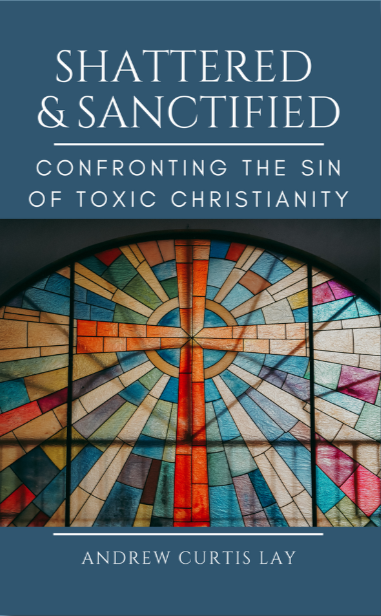
Last year, I published a book called Shattered and Sanctified: Confronting the Sin of Toxic Christianity. I didn't write it primarily for those who have already walked away from the church. I wrote it for those who are still in the church—those trying to make sense of their own church hurt and those seeking to better understand and care for people who have experienced church trauma. As I've gotten older, I've seen more and more of these stories. That's one of the biggest reasons I wrote this book. Today's post is an excerpt from this book. Whether you've experienced toxic Christianity firsthand or simply want to help create healthier communities of faith, I hope these words offer both honesty and hope.
The Church Lady is one of the most iconic characters in the history of Saturday Night Live. Comedian, Dana Carvey, adorned in a modest sweater and dress that falls below the knees, plays the role of Enid Strict. In these hilarious sketches, Enid—“the Church Lady,” as she is known—hosts her talk show, Church Chat, where she regularly attacks her guests, sarcastically pointing out their sinful and secular ways.
In one of the most notable sketches from 1987, the Church Lady interviews Jim and Tammy Faye Bakker (played by Phil Hartman and Jan Hooks) amid the aftermath of Jim Bakker’s affair with Jessica Hahn. The Church Lady, always quick to offer a word of judgment, utters her popular catchphrases, “Well, isn’t that special?” “How convenient!” and “Now, who could it be? Could it be… Satan?”
One of the reasons why this character is so funny is because she’s so familiar. We feel like we know her. She seems all too real. In fact, Dana Carvey confessed that the character is based on real women from his church growing up who kept track of people’s worship attendance. They were like security guards posted outside the church keeping tabs on the congregants and passing judgment.
Unfortunately, the church has a reputation for being judgmental and hypocritical. As a result, the church has turned many people away. In 2010, the novelist, Anne Rice, declared that she was leaving the church. In a Facebook post she wrote: I quit being a Christian. I’m out. I remain committed toChrist as always but not to being ‘Christian’ or to being part of Christianity. It's simply impossible for me to 'belong' to this quarrelsome, hostile, disputatious, and deservedly infamous group”
This is not an uncommon story. Many people have turned away from organized religion because the church has failed them, wounded them, betrayed them, or maybe even just bored them.
According to a Pew Research Study, the Christian majority in the U.S. has been shrinking for decades. In 1972, about 90% of Americans identified as Christian. As of 2020, that number has gone down to about 64%. If this trend continues, it is projected that the Christian population could drop as low as 35% by 2070. Our world is changing, and there are a lot of reasons for this decline, but one of the primary reasons is because of how the church has acted in the past.
Whether you are a longtime churchgoer or you rarely ever come to church, just about everybody has had a negative experience with the church or with someone who claims to be a Christian. Inevitably, someone in the church has shamed you, guilted you, or judged you.
I have been involved in the church my whole life, and I can personally attest to the harm that I have experienced by the church in the past. Conversely, I’m ashamed to confess that there have been times when I have not always lived up to the name of Christian in following the example of Christ.
In the church, we often get so focused on our traditions and on our way of doing things that we end up developing a different set of standards that have nothing to do with Christ. Church members make up rules and customs that turn into sacred cows, and when those cows are questioned, disrupted, or challenged in any way, some church members can lash out and respond with hostility.
A retired District Superintendent in the United Methodist Church once told me about a time when he and his wife walked into the sanctuary of a church located in the district he was serving. No one spoke a word to them. He grabbed a bulletin and found a seat in one of the pews.
After a few minutes, a man tapped him on the shoulder. The District Superintendent turned around, stuck out his hand for a handshake, and said, “Good morning.” The man, with his arms crossed, coldly replied, “You’re sitting in my seat.” So, the District Superintendent and his wife got up and found another pew to sit in. He concluded this story by telling me that this was not the only church where something like this had happened. In fact, he admitted that it happened quite often.
Think about that. If that was your first time ever going to church and that’s how you were treated, would you want to go back? I wouldn’t! That is the reason why our behavior as Christians is so serious. When someone is hurt by the body of Christ it is not just an emotional pain, but it’s a spiritual pain. This kind of behavior can negatively affect people’s relationship with the church, and it can even affect their faith and relationship with Christ.
In their book unChristian: What a New Generation Really Thinks About Christianity... and Why it Matters, David Kinnaman and Gabe Lyon share some research about some of the unsavory behaviors and attitudes demonstrated by many Christians. These behaviors have permanently turned many young people away from the church.
Their research concluded that 87 % of young adults who are not in church described Christians as judgmental. Likewise, 85 % of them described Christians as hypocritical. Overall, it is apparent that Christians have an image problem. To be fair, I don’t think Christians usually mean to be harmful. In fact, Christians, just like those outside the church, are flawed individuals. The Apostle Paul summarizes the scope of humanity’s sin by writing:
But now, apart from the law, the righteousness of God hasbeen disclosed and is attested by the Law and the Prophets, the righteousness of God through the faith of Jesus Christ forall who believe. For there is no distinction, since all have sinnedand fall short of the glory of God;” (Romans 3:21-23).
We are not perfect, we all sin, and we all fall short of the standards that God has set for our lives; however, this is not an acceptable excuse for the church to use. Christians cannot, and should not, use this Bible verse (or any Bible verse for that matter) as a cop-out for bad behavior.
Besides, God doesn’t let us off the hook that easily. God holds us to the highest standards, saying, “Youshall be holy, for I the Lord your God am holy” (Leviticus 19:2b; 1 Peter 1:16). We are called to be holy, not in a self-righteous way, but in a loving way. Christians are called to live a life that reflects the love of Christ. The Protestant Reformer Martin Luther believed that Christians were “simul justus et peccator” which is a Latin phrase meaning “simultaneously justified and a sinner.” Luther essentially proclaimed that Christians are simultaneously both saints and sinners. We are capable of committing acts of evil as well as performing works of righteousness. In his commentary on the book of Romans, Luther writes:
The saints in being righteous are at the same time sinners; they are righteous because they believe in Christ whose righteousness covers them and is imputed to them, but they are sinners because they do not fulfill the law and are not without sinful desires. They are like sick people in the care of a physician:they are really sick, but healthy only in the hope and insofar as they begin to be better, healed, i.e., they will become healthy. Nothing can harm them so much as the presumption that they are in fact healthy, for it will cause a bad relapse.
In other words, sinners can also be saints, not because of who we are or what we do, but because of who Christ is and what Christ has done for us. When we experience disruptions that pull us from living the lives that God has called us to live, we must remember God’s command of holiness. We must remember that we are called, first and foremost, to love God and to love our neighbor as we love ourselves.